Tuesday, May 17, 2011

Electron Configuration

For me, electron configurations started out very confusing, but now that I understand, I'll try and show you what works best for me.

First thing to do is to memorize this chart. We aren't given it during quizzes/tests so it is important to know the order.


You also need to know this:
S-types have one orbital (2 electrons or spaces)
P-types have 3 orbitals (6 electrons or spaces)

D-types have 5 orbitals (10 electrons or spaces)

F-types have 7 orbitals (14 electrons or spaces)

Now if I were you, I would be saying spaces? I'm confused!

But here is how it helps!

_    _      _ _ _    _      _ _ _
 
1s  2s    2p         3s    3p

Now, let's start with something easy like a Helium atom. If it is an atom, it has the same number of protons and electrons. Helium's atomic number is 2 therefore it has two protons/electrons. Because it has 2 electrons, fill in one upwards arrow and one downwards arrow. That shell is now full.

Not only is that shell full, we have used up all the electrons!
Therefore the electronic configuration for Helium is 1s2.

Lets use a more complicated one now and test that knowledge!
Lets try a sodium atom. This atom has 11 protons/electrons. Keep going until all those electrons are full.

I would draw it but since its on the computer I can't. So we'll use an astrix to show it.
 
**   **     ** ** **     *    
_     _       _ _ _            _     _ _ _

1s   2s     2p               3s    3p

As you can see we have used all 11 electrons. So let's write it!

In written form it would be 1s2 2s2 2p6 3s1
As you can see the exponents add up to the number of electrons.

If you are still completely confused what I mean when I say arrows, here is a visual example of what I am talking about.


                                                     Orbital diagram for Sodium


Now lets try one with ions!

Electron configuration for N3-

Because it has a charge of -3, there are three extra electrons to deal with. Normally, nitrogen has 7 electrons. But because of its charge, we have to add 3 more.
If it has 10 electrons, write it out until you run out of electrons.

1s2 2s2 2p6
As you can see the exponents add up to 10, the number of electrons for the N3- ion!

The nitride ion, N3­­­ˉ, has an electron arrangement of 1s2, 2s2, 2p6

Without the 3- charge, N would look like this: 1s2 2s2 2p3. The extra 3 electrons fill the 2p orbital and stabilizes the ion, making it similar to a noble gas, which all elements want to be like. (But you will learn more about that later)

What else you need to know:

Ground State: electrons are in their lowest possible level
Excited State: Electrons are in energy levels other than the one that is lowest available.

If the electrons in the excited state, you should try for extra practice to put them in their ground state.


Thanks for reading, of course I will include a lolcat to thank you for following along!

Saturday, May 14, 2011

Periodic Table Trends

This class we did an activity to discover the trends in the periodic table.

We found out the trends by graphing and finding out what we noticed was a trend.
Here is what we found:

Density: the degree of compactness of a substance. As the atomic number increases, so does the density.

Melting Point: The temperature at which a given solid will melt.
Boiling Point: The temperature at which a liquid boils and turns to vapor

Melting points decrease as you move down a group, and increase as you move across a period.

Ionization Energy: The energy required to remove the outermost electron in the atom. It increases as you move across a period, and decreases as you move down a group.


Electronegativity: The tendency of an atom to attract electrons in the formation of anionic bonds. Elements become less electronegative as you move down a group, and more electronegative when you move across a period.


Atomic Radius: Measure of the size of its atoms, usually the mean or typical distance from the nucleus to the boundary of the surrounding electrons. This decreases as you move across a period, and increases as you move down a group.
Next class we focused on elaborating on these trends so stay tuned!


Also, Ms. Chen showed us this great website http://www.ptable.com/ where you can play around with the trends and find out some new trends! I know I will be using it to study!

Friday, May 13, 2011

Atoms

Today you are going to learn how to determine things like isotopes, number of protons, number of neutrons, etc. So lets get started!


REVIEW: Atoms consist of electrons, protons and neutrons.


Proton: Mass = 1, charge = +1, located in the nucleus

Neutron: Mass >1, charge = 0, located in the nucleus

Electron: Charge = -1, located around the nucleus


Atomic Number: Number of protons found in a nucleus


The atomic number = the number of protons which also equals the number of electrons. It's that easy!


Got all that? Time to move on to ions.

Ions are atoms able to gain or lose electrons
The number of protons subtracted by the number of electrons equal the charge of the ion.

Moving on to the mass number. This is the total number of protons and neutrons!
Knowing this, here are some equations to remember:

number of neutrons = mass number - atomic number

mass number = number of protons + number of neutrons

Moving on to atomic mass!

Atomic Mass: the average mass of an isotope


Wondering what an isotope is?

Isotopes: when there is the same number of protons and electrons but a different number of neutrons


Here is a problem that deals with isotopes:

There is an element with 4 naturally occuring isotopes. Their atomic mass and percent is as follows: a = 46 (25%), b = 47 (50%), c = 48 (15%), and d = 49 (10%)

Find the atomic mass for the element.
First, multiply the atomic mass by the percent abundance.

A = 36 x 25 = 11.5
B = 47 x 50% = 23.5

C = 48 x 15% = 7.2

D = 49 x 10% = 4.9

Now add them together to get your answer.

11.5 + 23.5 + 7.2 + 4.9 = 47.1

I just high-fived my cat who is sitting beside me so I felt this picture was necessary.


Thanks for reading!

Thursday, April 14, 2011

More of a History Lesson!

Todays class was very different from the rest of the year!
So far we've pretty much done math and then more math that gets super confusing! But now we are starting the history part of chemistry 11.
Today we looked at the Atomic theory and Philosophers ideas of Atoms back in the day!
  • The first idea from Greek philosophers of atoms was that they were the smallest particles of matter.
  • Aristotle believed that matter was made from different combinations of earth, air, fire and water
  • Alchemists tried turning to turn common elements to gold
  • These ideas lasted for 2000 years
  • In 300BC Democritus; greek philosopher, thought atoms were invisible particles
Next we looked at a few philosophers and talked about their theories on matter!
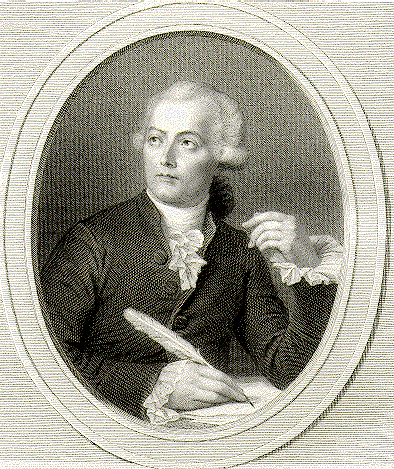
Lavoisier
1. Lavoisier

  • He created the first version of the law of conservation of mass, and the law of definite proportions
  • he was the first to recognize and name Oxygen(1778) and Hydrogen(1785)

2.Proust
  • He experimentally proved Lavoisier law
  • Dalton
  • he stated that ratio of elements will stay the same before and after.
3. Dalton
  • idea that atoms are solid, indestructible spheres
  • atoms provide for different elements, based on the law of conservative mass
5 main points of Dalton's Atomic Theory
  1. elements are made of tiny particles
  2. all atoms of a given elements are identical
  3. all atoms of a given element are different from those of any other element
  4. Atoms of one element ca combine with atoms of other elements to from chemical compounds
  5. atoms can not be created nor destroyed, only changed
4. J.J. Thomson (1850)
planetary model
5. Rutherford (1908)
  • discovered the nucleus and that electrons orbit the nucleus
  • created planetary model
  • claimed atoms were mostly empty space
 Atomic Theory IV

Niels Bohr
6. Niels Bohr (1885-1962)
  • observations, electrons surrounding the nucleus had specific "energy levels" or "shells"
  • Pictured hydrogen atoms having energy "levels"
  • and that they could jump to higher levels
  • release light when it comes back down
The Modern Atom

  •  atom is the smallest particle of an element
  •  all atoms are made up of 3 subatomic particlles

  1. electrons
  2. protons
  3. neutrons


Lastly we got assigned a Timeline to do for April 20
we have to research 12 scientists and construct a time line
  1. Aristotle
  2. Henri Becquerel
  3. Niels Bohr
  4. James Chadwick
  5. Marie & Pierre Curie
  6. John Dalton
  7. Democritus
  8. Robert Millikan
  9. Ernest Rutherford
  10. J.J. Thomson
  11. Antoine Lavoisier
  12. Henry Mosely
A few of these scientists were discussed today in class as shown above!

Monday, April 11, 2011

Percent Yield and Percent Purity

Percent Yield =   actual mass produced (grams)         x 100
              theoretical mass produced (grams)


Percent Yield is found by dividing the actual mass of product formed by the mass of the product expected - aka, the product that is found by using Stoichiometry

For example:
If 14g of Sodium is reacted with an excess of Chlorine, then 36.5g of Sodium Chloride is produced. What is the percent yield? 
There are 3 steps.

Step 1: Balance the equation.
Na + Cl2 --> NaCl2 
Luckily for this equation, it's already balanced. So this step is done for you

Step 2: Use Stoichiometry! 
So we know that we have 14g of Sodium (Na), and we're trying to convert from grams to moles to moles to grams. In this case, were converting it from sodium to sodium chloride (NaCl2) 

so:
14g Na x 1 mole/23g x 1 mole NaCl2/1 mole Na x 94g/1 mole = 57.217g NaCl2

Step 3: Find Percent yield.
    36.5g (actual mass produced)        x 100  
57.217g (theoretical mass produced)

= 63.8% 


^ a quick video on Percent yield (in case you don't understand)


Percent Purity=   Mass of pure substance    x 100
               Mass of impure sample


Percent Purity is found by dividing the mass of the pure substance by the mass of the impure sample, and then multiplying by 100. Only the pure part of the sample will react. Before we can use stoichiometry to find out how much of the product will form, we need to know how much of the reactant is pure - and able to react.

For example:
If a 9.2g sample of metal ore contains 3.2g of Copper, what is the percent purity?

So the mass of the pure substance = 3.2g of copper.
The mass of the impure sample = 9.2g of metal ore.

Percent Purity =  3.2g    x 100 = 34.8% pure.
                          9.2g 

unfortunately could not find any you tube videos on percent purity but please enjoy this picture of a polar bear


Stoichiometry Part II

So now it is time to turn up the difficulty! You ready?! Well if you're not too bad.


Let's try some examples! The important thing is to create a map and keep organized.

If 121.5 g of Al are consumed, what volume of hydrogen gas is formed at STP?

Plan: mass Al --> moles Al --> moles H2 ---> volume STP

conversion factor for volume is 22.4 L / 1 mol or 1 mol/22.4 L

also, remember your sig figs or you'll get marks off! bad bad bad you dont want that!

121.5 g Al x 1 mol Al  x   3 mol H2    x   22.4 mol H2 = 151 L H2
                    _______      _______         _________
                    27.0 g Al      2 mol Al          1 mol H2

Lets try more!

3Cu(s) + 8HNO3 (aq) + 3Cu(NO3)2 (aq) + 2NO (g) + 4H20 (l)

How many atoms of copper are required to produce 179.2 L of NO gas at STP?

Let's plan!

volume NO --> mol NO --> mol Cu -->  atoms Cu

6.022 x 10 ^ 23 atoms
--------------------
1 mole

is the conversion factor we need to help us solve this problem!

179.2 L NO gas x 1 mol NO x 3 mol Cu x 6.022 x 10^23 atoms Cu
                              ---------     ---------    --------------------------
                              22.4 L       2 moles NO   1 mol Cu

= 7.22 x 10^24 atoms of Cu

There you go! Now you know how to do stoichiometry with atoms, volume at STP and molecules thrown into the mix. You're invincible!

Here are some videos in case you aren't feeling invincible, but I doubt you're not.
Volume to Volume
mass to volume
mass to mass
                             ---------

Excess and Limiting Reactants

During a chemical reaction, there is not always the correct amount of each reactant present in the ratio in the balanced equation. Obviously, more = excess and less = limiting

These questions take a while to do and require a lot of steps so remember to keep organized. Alright, here is how to do it!

Lets start off with an example:

Fe + S --> FeS

A sample of 111.6 g of Fe is mixed with 96.3 g of S.

First thing to check is that the equation is balanced. After that, you must calculate the moles present.

moles present Fe = 111.6 g Fe x 1 mol Fe/55.8 g Fe = 2.00 mol present Fe

moles present S = 96.3 g S x 1 mol S/32.1 g S = 3.00 mol S present

So now we have our moles present. But how do we know which one is limiting and which one is excess? Well, we must calculate the moles needed.

Use the coefficients in the equation to determine the moles needed.

moles needed S = 2.00 mol Fe x 1 mol S / 1 mol Fe = 2.00 mol S needed

Using moles present and moles needed we can calcullate the excess and limiting reactants.

With 3.00 mols S present, and 2.00 mols S needed, S is the excess reactant. 3.00-2.00=1.00 g in excess

Therefore, if S is the excess reactant than Fe is the limiting reactant!

A question that will typically be asked is:

When this reaction is carried out, what mass of FeS will actually be produced?

To calculate the mass of FeS actually formed in this reaction, we have to start with the limiting reactant (this time Fe). We can't use the limiting reactant since not all of it reacts.
To get the answer, use the stoicheometry we have learned.

Remember to plan first.

mass Fe --> moles Fe ---> moles FeS --> mass FeS

Just write it all out and you are good to go! Lets try another.

4FeS + 7O2 --> 2Fe2O3 + 4SO2


moles present FeS = 439.5 g FeS x 1 mol FeS/87.9 g FeS = 5.00 mol FeS
moles present O2 = 256.0 g O2 x 1 mol O2/32.0 g O2 = 8.00 mol O2

moles needed O2 = 5.00 mol FeS x 7 mol O2/4 mol FeS = 8.75 mol O2

Therefore O2 is the limiting reactant and FeS is the excess reactant.

Hope that helped! Here are some fun videos:

Click!

More!