Thursday, April 14, 2011

More of a History Lesson!

Todays class was very different from the rest of the year!
So far we've pretty much done math and then more math that gets super confusing! But now we are starting the history part of chemistry 11.
Today we looked at the Atomic theory and Philosophers ideas of Atoms back in the day!
  • The first idea from Greek philosophers of atoms was that they were the smallest particles of matter.
  • Aristotle believed that matter was made from different combinations of earth, air, fire and water
  • Alchemists tried turning to turn common elements to gold
  • These ideas lasted for 2000 years
  • In 300BC Democritus; greek philosopher, thought atoms were invisible particles
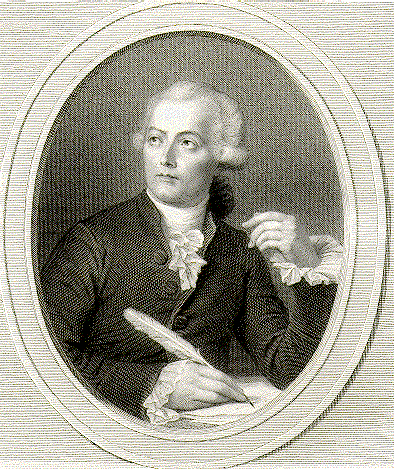
Next we looked at a few philosophers and talked about their theories on matter!
Lavoisier
1. Lavoisier

  • He created the first version of the law of conservation of mass, and the law of definite proportions
  • he was the first to recognize and name Oxygen(1778) and Hydrogen(1785)

2.Proust
  • He experimentally proved Lavoisier law
  • Dalton
  • he stated that ratio of elements will stay the same before and after.
3. Dalton
  • idea that atoms are solid, indestructible spheres
  • atoms provide for different elements, based on the law of conservative mass
5 main points of Dalton's Atomic Theory
  1. elements are made of tiny particles
  2. all atoms of a given elements are identical
  3. all atoms of a given element are different from those of any other element
  4. Atoms of one element ca combine with atoms of other elements to from chemical compounds
  5. atoms can not be created nor destroyed, only changed
4. J.J. Thomson (1850)
planetary model
5. Rutherford (1908)
  • discovered the nucleus and that electrons orbit the nucleus
  • created planetary model
  • claimed atoms were mostly empty space
 Atomic Theory IV

Niels Bohr
6. Niels Bohr (1885-1962)
  • observations, electrons surrounding the nucleus had specific "energy levels" or "shells"
  • Pictured hydrogen atoms having energy "levels"
  • and that they could jump to higher levels
  • release light when it comes back down
The Modern Atom

  •  atom is the smallest particle of an element
  •  all atoms are made up of 3 subatomic particlles

  1. electrons
  2. protons
  3. neutrons


Lastly we got assigned a Timeline to do for April 20
we have to research 12 scientists and construct a time line
  1. Aristotle
  2. Henri Becquerel
  3. Niels Bohr
  4. James Chadwick
  5. Marie & Pierre Curie
  6. John Dalton
  7. Democritus
  8. Robert Millikan
  9. Ernest Rutherford
  10. J.J. Thomson
  11. Antoine Lavoisier
  12. Henry Mosely
A few of these scientists were discussed today in class as shown above!

Monday, April 11, 2011

Percent Yield and Percent Purity

Percent Yield =   actual mass produced (grams)         x 100
              theoretical mass produced (grams)


Percent Yield is found by dividing the actual mass of product formed by the mass of the product expected - aka, the product that is found by using Stoichiometry. 

For example:
If 14g of Sodium is reacted with an excess of Chlorine, then 36.5g of Sodium Chloride is produced. What is the percent yield? 
There are 3 steps.

Step 1: Balance the equation.
Na + Cl2 --> NaCl2 
Luckily for this equation, it's already balanced. So this step is done for you

Step 2: Use Stoichiometry! 
So we know that we have 14g of Sodium (Na), and we're trying to convert from grams to moles to moles to grams. In this case, were converting it from sodium to sodium chloride (NaCl2) 

so:
14g Na x 1 mole/23g x 1 mole NaCl2/1 mole Na x 94g/1 mole = 57.217g NaCl2

Step 3: Find Percent yield.
    36.5g (actual mass produced)        x 100  
57.217g (theoretical mass produced)

= 63.8% 


^ a quick video on Percent yield (in case you don't understand)


Percent Purity=   Mass of pure substance    x 100
               Mass of impure sample


Percent Purity is found by dividing the mass of the pure substance by the mass of the impure sample, and then multiplying by 100. Only the pure part of the sample will react. Before we can use stoichiometry to find out how much of the product will form, we need to know how much of the reactant is pure - and able to react.

For example:
If a 9.2g sample of metal ore contains 3.2g of Copper, what is the percent purity?

So the mass of the pure substance = 3.2g of copper.
The mass of the impure sample = 9.2g of metal ore.

Percent Purity =  3.2g    x 100 = 34.8% pure.
                          9.2g 

unfortunately could not find any you tube videos on percent purity but please enjoy this picture of a polar bear


Stoichiometry Part II

So now it is time to turn up the difficulty! You ready?! Well if you're not too bad.


Let's try some examples! The important thing is to create a map and keep organized.

If 121.5 g of Al are consumed, what volume of hydrogen gas is formed at STP?

Plan: mass Al --> moles Al --> moles H2 ---> volume STP

conversion factor for volume is 22.4 L / 1 mol or 1 mol/22.4 L

also, remember your sig figs or you'll get marks off! bad bad bad you dont want that!

121.5 g Al x 1 mol Al  x   3 mol H2    x   22.4 mol H2 = 151 L H2
                    _______      _______         _________
                    27.0 g Al      2 mol Al          1 mol H2

Lets try more!

3Cu(s) + 8HNO3 (aq) + 3Cu(NO3)2 (aq) + 2NO (g) + 4H20 (l)

How many atoms of copper are required to produce 179.2 L of NO gas at STP?

Let's plan!

volume NO --> mol NO --> mol Cu -->  atoms Cu

6.022 x 10 ^ 23 atoms
--------------------
1 mole

is the conversion factor we need to help us solve this problem!

179.2 L NO gas x 1 mol NO x 3 mol Cu x 6.022 x 10^23 atoms Cu
                              ---------     ---------    --------------------------
                              22.4 L       2 moles NO   1 mol Cu

= 7.22 x 10^24 atoms of Cu

There you go! Now you know how to do stoichiometry with atoms, volume at STP and molecules thrown into the mix. You're invincible!

Here are some videos in case you aren't feeling invincible, but I doubt you're not.
Volume to Volume
mass to volume
mass to mass
                             ---------

Excess and Limiting Reactants

During a chemical reaction, there is not always the correct amount of each reactant present in the ratio in the balanced equation. Obviously, more = excess and less = limiting

These questions take a while to do and require a lot of steps so remember to keep organized. Alright, here is how to do it!

Lets start off with an example:

Fe + S --> FeS

A sample of 111.6 g of Fe is mixed with 96.3 g of S.

First thing to check is that the equation is balanced. After that, you must calculate the moles present.

moles present Fe = 111.6 g Fe x 1 mol Fe/55.8 g Fe = 2.00 mol present Fe

moles present S = 96.3 g S x 1 mol S/32.1 g S = 3.00 mol S present

So now we have our moles present. But how do we know which one is limiting and which one is excess? Well, we must calculate the moles needed.

Use the coefficients in the equation to determine the moles needed.

moles needed S = 2.00 mol Fe x 1 mol S / 1 mol Fe = 2.00 mol S needed

Using moles present and moles needed we can calcullate the excess and limiting reactants.

With 3.00 mols S present, and 2.00 mols S needed, S is the excess reactant. 3.00-2.00=1.00 g in excess

Therefore, if S is the excess reactant than Fe is the limiting reactant!

A question that will typically be asked is:

When this reaction is carried out, what mass of FeS will actually be produced?

To calculate the mass of FeS actually formed in this reaction, we have to start with the limiting reactant (this time Fe). We can't use the limiting reactant since not all of it reacts.
To get the answer, use the stoicheometry we have learned.

Remember to plan first.

mass Fe --> moles Fe ---> moles FeS --> mass FeS

Just write it all out and you are good to go! Lets try another.

4FeS + 7O2 --> 2Fe2O3 + 4SO2


moles present FeS = 439.5 g FeS x 1 mol FeS/87.9 g FeS = 5.00 mol FeS
moles present O2 = 256.0 g O2 x 1 mol O2/32.0 g O2 = 8.00 mol O2

moles needed O2 = 5.00 mol FeS x 7 mol O2/4 mol FeS = 8.75 mol O2

Therefore O2 is the limiting reactant and FeS is the excess reactant.

Hope that helped! Here are some fun videos:

Click!

More!

Tuesday, March 1, 2011

Stoichiometry

Today we started chapter 6 - stoichiometry.
Stoichi-what?
"stoichio" is Greek for element.
"metry" means measurement.
Stoichiometry is measuring the amounts of chemicals involved in a reaction.

Proportional relationships are the specific amounts of each compound in a reaction.

2Cu + 1O2 -> 2CuO

Suppose you double the amounts of copper and oxygen used.

4Cu + 2O2 -> 4CuO

In a balanced equation, you can continue to increase the amounts of the compounds as long as the proportions are kept the same.
-link to PHET website

This website explains all about proportional relationships and gives you an opportunity to try it out. There's even a game!

The balanced equation describes the ratio in which the substances combine. The ratio is obtained from the coefficients of the balanced equation. This combining ratio is the mole ratio of the combining substances. It can be used to predict what would happen if the amount of one substance is changed.

Now back to stoichiometry. Stoichiometry involves measuring or calculating the amounts of elements or compounds involved in a chemical change.
Coefficients in a balanced equation tell us the numbers of moles reacted or produced. They can also be used as conversion factors.

3X + Y -> 2Z

To find the ratios you just take what you need/what you have OR where you're going/where you started.

Thursday, February 24, 2011

Types of Reactions, Predicting Products

This post is about the types of reactions, and predicting products of those reactions!

There are several types of reactions:
Synthesis, Decomposition, Single Replacement, Double Replacement, Combustion, and Neutralization

SYNTHESIS: A + B --> AB

This is just your simple 1+1 = 2. Add two together!

Example: Fe(s) + O2(g) --> Fe2O3

Don't forget to balance!
4Fe(s) + 3O2(g) --> 2FeO3

Don't forget to include the states! If you are confused, check out the solubility table!

DECOMPOSITION: AB --> A + B

When something decomposes, it breaks up. Decomposers break up stuff! So think about breaking up the compound:
Think of that gross pile of worms to remember decomposition.

Example: 1SO2(g) --> 1S(g) + 1O2(g)

SINGLE REPLACEMENT: AB + C --> AC + B

In single replacement, they switch partners. But there are only 3 different elements: A, B and C. Remember to put metals with non-metals. Do not put metals together with metals or vice versa. That would be wrong!

4Al(s) + 3Pb(NO3)4 (aq) --> 4Al(NO3)3 (aq) + 3Pb(s)

Ready to step it up a notch?

DOUBLE REPLACEMENT: AB + CD --> AC + CB

There are four different elements in this reaction, so switch them up! Again, put metals with non-metals.

2Sr(OH)2(aq) + 1Sn(NO3)4(aq) --> 2Sr(NO3)2(aq) + 1Sn(OH)4(s)

Now I have skipped a bit into the next lesson, but more practice for you guys! Moving on!

PREDICTING REACTANTS

When we know the type of reaction, we can predict the products. Just use the ABCD models that are given above.

Let's try it out:

1Al(s) + 3AgNO3(aq) -->

From looking at this, we can see that there are two elements and one compound. What could this be?!
The key word is the compound. Decomposition would have just one compound, and synthesis would have two different elements that would form a compound on the other side of the arrow.

So what could it be? Single replacement, of course!

Trashcat does not like single replacement.

So, if it is single replacement then lets finish it off!
1Al(s) + 3AgNO3(aq) --> 1Al(NO3)3(aq) + 3Ag(s)

That is it for today!

Good luck on the test, make me proud!

Tuesday, February 22, 2011

Enthalpy and Energy Calculations

It's the RETURN OF THE MOLE! 


ok in all seriousness now, today we learnt about Enthalpy and how to calculate energy to moles.

Enthalpy: the total Kinetic and Potential Energy of a substance - the "heat content" of a substance.
Chemists are interested in the change in enthalpy in a chemical reaction. 
In an exothermic reaction, the enthalpy goes DOWN. It is converted into heat and released. 
In an endothermic reaction, the enthalpy goes UP. It is absorbed. 

/\H = Hproduct - Hreactant 
To find the total change in enthalpy, you just subtract the reactant from the product. 

In this picture, C is in the place where the change in Enthalpy would normally be. 
/\H = Hproduct - Hreactant 
/\H = 300 - 100 
/\H = 200 kJ
As you should already know, the unit for enthalpy is kJ, or kilojoules. 

Energy to moles: 
Here is a mole map.

Here is a mole map, with the calculations for Energy -> moles.

As you can see, to get from moles to energy, you simply multiply by the number of kilojoules/1 mole. To get from energy to moles, you multiply by 1 mole/number of kilojoules.

Wahooooo